Showing posts with label Notes. Show all posts

Thursday, October 27, 2016

Business Plan Notes

Executive Summary

  • Summarizes business plan 
    • Answers the Following Questions
      • What does your company do?
    • States:
      • Exactly what your company does
    • Format
      • Bullet-Points
    • Length
      • Short and Concise
      • Less than two-pages
    • Tone
      • Confidence
Mission Statement
  • Tells what you do and for whom you do it for
    • Answers the Following Questions?
      • What does your company do, and for whom does your company do it for?
    • States:
      • The company's purpose
    • Format
      • A sentence or two.
    • Length
      • A sentence or two.
    • Tone
      • Informative/Inspirational 
      • Clear and Concise
Company Background
  • Answers the following Questions
    • When did the company form?
    • Who formed the company?
    • For what purpose was this company formed?
    • How close is your company to achieving its purpose?
Product/Service Description
  • Provide a brief description of what you provide
  • Answer the following Questions
    • Who are your customers?
    • How has your company grown overtime?
    • What are your company's goals for the future?
Marketing Plan
  • Answers the Following Questions
    • How will you achieve your sales and customer goals?
    • What is your plan for attracting and retaining customers?
  • What types of supporting evidence do you want to include?
    • Facts
    • Numerical Data
Competitor Analysis
  • Answers the Following Questions
    • Who are your competitors?
    • What are your competitors' strengths and weaknesses?
    • What are the objectives of your competitors?
    • How can your company take the market share of your competitors?
SWOT Analysis
  • Answers the Following Questions
    • What are your company's strengths?
    • What are your company's weaknesses?
    • What opportunities does your company have that will allow it to become more successful?
    • What are threats that your company faces that could inhibit your company from becoming more successful?
Operations

  • Answers the Following Questions
    • What materials/labor/resources do you have in order to accomplish your goals?
    • What are the resources you utilize to complete activities?
Financial Planning
  • Answers the Following Questions
    • How is your company going to accrue additional funds?
    • How do you obtain revenue?
    • What are your costs? 
Timeline
  • Answers the Following Questions
    • How far are you currently in achieving your goals?
    • What goals would you like to achieve?
    • How are you going to achieve your goals?
  • Supporting Evidence
    • Graph to show projections of possible growth
      • Include anticipated income and expenses

Thursday, October 20, 2016

Chinese Project Notes: October 20 2016

Cite For My Source

Yu, GZ. "Scattered Health" in Chinese Cities of the Middle Imperial Period." Chinese Studies In History 47, no. 4 (n.d.): 7-37. Arts & Humanities Citation Index, EBSCOhost (accessed October 23, 2016).

Pg. 3

Disease was attributed to the mystical energy of Qi.

" The ancient Chinese understanding of disease naturally lacked the concept of bacteria and viruses, but qi (气 air or energy) is a factor worth exploring, especially with regards to infectious or epidemic diseases. Qi was regarded as a vehicle for disease: it has passed through many interpretations and can be used to patch the holes in many theories, while its characteristics led people to believe that it could be avoided or resisted but could not be eradicated through public methods."

Pg: 6

Upper-Middle Class Were Served By Physicians

Most people worked with shamans and those who practiced witchcraft.

"many people believed in witches and not in doctors"

" The prevalent practice of moxibustion is one example. The government also encouraged the people to practice self-care: thus, when facing the threat of disease, doctors were never the only force of resistance. Moreover, doctors in ancient China lacked support from religious groups, instead relying completely on the market. As a result, they had only to meet the needs of the “class served by physicians” (primarily the upper-middle class)."

Pg. 7

Doctors didn't actively work to help the populace. Most people didn't trust doctors.

"“Many doctors have adopted this trade in name but not in substance; yet they cultivate an empty reputation in pursuit of material benefit.”9 Arguably, both the elite physicians, who held discursive power, and the lower-class physicians, who constituted the majority in the trade, lacked the motivation to consider the health of the entire populace. According to the doctor–patient relationship of that era, doctors were accustomed to simply wait passively for patients to summon them and lacked the motivation to participate actively in public affairs. For this reason, when facing a large-scale epidemic event, doctors did not necessarily believe that they were the primary line of defense. They had no lack of social responsibility, but they did not elevate this sense of responsibility to the motivation and capacity to take “health measures.”"

General Notes #1

This makes sense because their beliefs were focused around the manipulation of Qi, they believed disease was caused by supernatural entities. Who would you trust to combat negative, supernatural entities? Would you prefer an uneducated doctor attempt to use random medicine to help you, that you don't understand, or would you rather someone who understands the supernatural, help you overcome the supernatural. Even with people trusting shamans more than doctors, the government encouraged self-care, people were motivated to help themselves overcome illness. There are even fatalists who believed that everything is fate, and didn't even fight illness.

General Notes #2

Nicholas Benson: Imagine you are living in Han Dynasty, China. You believe that all disease is caused by a mystical energy, known as Qi. Most doctors are doctor by name alone, and aren't very intelligent. Religious groups don't support the practices of these doctors, and the most elitist doctors are more focused on achieving personal immortality, rather than on public health. Speaking of public health, there is no word for 'health'. The government encourages you take care of yourself, and your friend down the street is a fatalist, so he believes getting sick is simply fate. He's probably going to die soon. Your other neighbor is a shaman, who claims to understand how to manipulate Qi, and help people overcome illness. What is the point of you visiting an uninformed doctor, or a doctor that is more motivated by personal gain, when you can take care of yourself, or visit a shaman down the road who truly understands your troubles?! If you are a member of the lower class, the cheapest option is to take care of yourself, after all, your government thinks its a good idea. If you are middle class, more than likely you don't trust doctors due to their negative reputation. More than likely you'll see a shaman. If you were Upper-Middle Class, more than likely you actually went to see a doctor. Upper-middle class citizens can afford the services of elitist doctors.


Image Citations

2016. Image. http://archive.artsmia.org/art-of-asia/history/images/maps/china-han-large.gif.

2016. Image. https://pixabay.com/static/uploads/photo/2016/02/21/09/33/buddha-1213332_960_720.jpg.

2016. Image. https://pixabay.com/static/uploads/photo/2014/03/20/04/53/martial-arts-291046_960_720.jpg.

2016. Image. https://pixabay.com/static/uploads/photo/2016/04/20/15/36/yin-1341378_960_720.png.

2016. Image. https://pixabay.com/static/uploads/photo/2015/04/12/07/35/hands-718560_960_720.jpg.

Han Dynasty Map. 2016. Image. http://www.nationsonline.org/maps/chinese_dynasty_maps/Han_Dynasty_Map.jpg.


Image Citations for All Group Images


  1. 2016. Image. http://archive.artsmia.org/art-of-asia/history/images/maps/china-han-large.gif.
  2. 2016. Image. https://pixabay.com/static/uploads/photo/2016/02/21/09/33/buddha-1213332_960_720.jpg.
  3. 2016. Image. https://pixabay.com/static/uploads/photo/2014/03/20/04/53/martial-arts-291046_960_720.jpg.
  4. 2016. Image. https://pixabay.com/static/uploads/photo/2016/04/20/15/36/yin-1341378_960_720.png.
  5. 2016. Image. https://pixabay.com/static/uploads/photo/2015/04/12/07/35/hands-718560_960_720.jpg.
  6. 2016. Image. https://nirc.nanzan-u.ac.jp/nfile/1113.


Script Rough Draft One

Isaac: All classes of Chinese society, except for slaves, had practitioners of medicine. The majority of Chinese citizens were of the lower class. Lower class Chinese citizens, were born into their professions. Medical traditions were passed down from father to son, and even from mother to daughter. Despite the large number of medical practitioners in the lower class, a majority of records only reference the existence of elite physicians. A majority of records may only refer to the existence of elite physicians, due to their ability to read and write.

Lydia: Common folk did not seek doctors, as they often practiced self-care. Those who practiced self-care utilized methods such as moxibustion, acupuncture, massages, gymnastics, and the ingestion of different herbs. Moxibustion is the burning of dried moxa leaves, directly upon one's skin. Acupuncture is the practice of inserting small needles into different points of the body, in order to regulate the flow of Qi, throughout the body. The ingestion of herbs were used as both cures for diseases, as well as a proactive measure to prevent illness.

Derek: Doctors lacked a high reputation among most social classes in Han Dynasty China. Many individuals practiced folk medicine. Folk medicine was heavily derived from the survival practices developed by hunters-gatherers of the Neolithic era.  Folk medicine wasn't entirely ineffective, even though many of the practices may sound odd to those of the modern day. For example the licking of wounds may sound strange, but little were those practicing Folk Medicine were aware of, enzymes in one's saliva actually do help to resist disease. 

Henry: Upper-class physicians and Folk Medicine used different methods for spreading medical knowledge. Upper-class physicians practiced traditional medicine. Traditional medicine was codified. Folk medicine was spread orally. Traditional medicine was more likely more consistent in practice, as doctors could refer back to the same texts, and use the same methods. Folk medicine practitioners relying on oral records, more than likely contained gradual shifts in methodology, as their practiced are spoken and changing throughout time to new generations.

Jet: Imagine you are living in Han Dynasty, China. You believe that all disease is caused by a mystical energy, known as Qi. Most doctors are doctor by name alone, and aren't very intelligent. Religious groups don't support the practices of these doctors, and the most elitist doctors are more focused on achieving personal immortality, rather than on public health. Speaking of public health, there is no word for 'health'. The government encourages you take care of yourself, and your friend down the street is a fatalist, so he believes getting sick is simply fate. He's probably going to die soon. Your other neighbor is a shaman, who claims to understand how to manipulate Qi, and help people overcome illness. What is the point of you visiting an uninformed doctor, or a doctor that is more motivated by personal gain, when you can take care of yourself, or visit a shaman down the road who truly understands your troubles?! If you are a member of the lower class, the cheapest option is to take care of yourself, after all, your government thinks its a good idea. If you are middle class, more than likely you don't trust doctors due to their negative reputation. More than likely you'll see a shaman. If you were Upper-Middle Class, more than likely you actually went to see a doctor. Upper-middle class citizens can afford the services of elitist doctors.

Script Rough Draft Two

(0:00-1:00) Jet: Imagine you are living in Han Dynasty, China. You believe that all disease is caused by a mystical energy, known as Qi. Most doctors are doctor by name alone, and aren't very intelligent. Religious groups don't support the practices of these doctors, and the most elitist doctors are more focused on achieving personal immortality, rather than on public health. Speaking of public health, there is no word for 'health'. The government encourages you take care of yourself, and your friend down the street is a fatalist, so he believes getting sick is simply fate. He's probably going to die soon. Your other neighbor is a shaman, who claims to understand how to manipulate Qi, and help people overcome illness. What is the point of you visiting an uninformed doctor, or a doctor that is more motivated by personal gain, when you can take care of yourself, or visit a shaman down the road who truly understands your troubles?! If you are a member of the lower class, the cheapest option is to take care of yourself, after all, your government thinks its a good idea. If you are middle class, more than likely you don't trust doctors due to their negative reputation. More than likely you'll see a shaman. If you were Upper-Middle Class, more than likely you actually went to see a doctor. Upper-middle class citizens can afford the services of elitist doctors.

(1:01-2:00) Lydia: Common folk did not seek doctors, as they often practiced self-care (Geng Zhe 2014, 10-17). Those who practiced self-care utilized methods such as moxibustion, acupuncture, massages, gymnastics, and the ingestion of different herbs (Needham 2000, 38-115 ). Moxibustion is the burning of dried moxa leaves, directly upon one's skin. Acupuncture is the practice of inserting small needles into different points of the body, in order to regulate the flow of Qi, throughout the body. The ingestion of herbs were used as both cures for diseases, as well as a proactive measure to prevent illness.

(2:01-3:00) Isaac: All classes of Chinese society, except for slaves, had practitioners of medicine(Lloyd and Sivin 2002, 22). The majority of Chinese citizens were of the lower class. Lower class Chinese citizens, were born into their professions. Medical traditions were passed down from father to son, and even from mother to daughter (Lloyd and Sivin 2002, 79). Despite the large number of medical practitioners in the lower class, a majority of records only reference the existence of elite physicians. A majority of records may only refer to the existence of elite physicians, due to their ability to read and write (Lloyd and Sivin 2002, 25).

(3:01-4:00) Henry: Upper-class physicians and Folk Medicine used different methods for spreading medical knowledge. Upper-class physicians practiced traditional medicine. Traditional medicine was codified. Folk medicine was spread orally. Traditional medicine was more likely more consistent in practice, as doctors could refer back to the same texts, and use the same methods. Folk medicine practitioners relying on oral records, more than likely contained gradual shifts in methodology, as their practiced are spoken and changing throughout time to new generations (Schiffiler 1980, 48) .

(4:01-5:00) Derek: Doctors lacked a high reputation among most social classes in Han Dynasty China. Many individuals practiced folk medicine. Folk medicine was heavily derived from the survival practices developed by hunters-gatherers of the Neolithic era.  Folk medicine wasn't entirely ineffective, even though many of the practices may sound odd to those of the modern day. For example the licking of wounds may sound strange, but little were those practicing Folk Medicine were aware of, enzymes in one's saliva actually do help to resist disease (Schiffiler 1976, 2) . 


Chicago In-Text Citations For Everyone

Isaac: (Lloyd and Sivin 2002, 22-79)
Jet: (Geng Zhe 2014, 10-17)
Lydia: (Needham 2000, 38-115 )
Derek: (Schiffiler 1976, 2) 
Henry: (Schiffiler 1980, 48) 

Final Project So Far

Video Script


(0:00-1:00) Jet: Today we will discuss whether or not there are any differences in medicine in the Han Dynasty, involving the class system. We want you to understand that people of different classes, in Han Dynasty China, followed different medical practices. Our topic is especially significant because for many years, and even today, class has had an impact on many elements of people’s everyday life. By understanding how class impacted early societies around the world in regard to medicine, we can better understand how class affects today’s society. Imagine you are living in Han Dynasty, China. You believe that all disease is caused by a mystical energy, known as Qi. Most doctors are doctor by name alone, and aren't very intelligent. Religious groups don't support the practices of these doctors, and the most elitist doctors are more focused on achieving personal immortality, rather than on public health. Speaking of public health, there is no word for 'health'. The government encourages you take care of yourself, and your friend down the street is a fatalist, so he believes getting sick is simply fate. He's probably going to die soon. Your other neighbor is a shaman, who claims to understand how to manipulate Qi, and help people overcome illness. What is the point of you visiting an uninformed doctor, or a doctor that is more motivated by personal gain, when you can take care of yourself, or visit a shaman down the road who truly understands your troubles?! If you are a member of the lower class, the cheapest option is to take care of yourself, after all, your government thinks it’s a good idea. If you are middle class, more than likely you don't trust doctors due to their negative reputation. More than likely you'll see a shaman. If you were Upper-Middle Class, more than likely you actually went to see a doctor. Upper-middle class citizens can afford the services of elitist doctors.

(1:01-2:00) Lydia: Common folk did not seek doctors, as they often practiced self-care (Geng Zhe 2014, 10-17). Those who practiced self-care utilized methods such as moxibustion, acupuncture, massages, gymnastics, and the ingestion of different herbs (Needham 2000, 38-115 ). Moxibustion is the burning of dried moxa leaves, directly upon one's skin. Acupuncture is the practice of inserting small needles into different points of the body, in order to regulate the flow of Qi, throughout the body. The ingestion of herbs were used as both cures for diseases, as well as a proactive measure to prevent illness.

(2:01-3:00) Isaac: All classes of Chinese society, except for slaves, had practitioners of medicine(Lloyd and Sivin 2002, 22). The majority of Chinese citizens were of the lower class. Lower class Chinese citizens, were born into their professions. Medical traditions were passed down from father to son, and even from mother to daughter (Lloyd and Sivin 2002, 79). Despite the large number of medical practitioners in the lower class, a majority of records only reference the existence of elite physicians. A majority of records may only refer to the existence of elite physicians, due to their ability to read and write (Lloyd and Sivin 2002, 25).

(3:01-4:00) Henry: Upper-class physicians and Folk Medicine used different methods for spreading medical knowledge. Upper-class physicians practiced traditional medicine. Traditional medicine was codified. Folk medicine was spread orally. Traditional medicine was more likely more consistent in practice, as doctors could refer back to the same texts, and use the same methods. Folk medicine practitioners relying on oral records, more than likely contained gradual shifts in methodology, as their practiced are spoken and changing throughout time to new generations (Schiffiler 1980, 48) .

(4:01-5:00) Derek: Doctors lacked a high reputation among most social classes in Han Dynasty China. Many individuals practiced folk medicine. Folk medicine was heavily derived from the survival practices developed by hunters-gatherers of the Neolithic era.  Folk medicine wasn't entirely ineffective, even though many of the practices may sound odd to those of the modern day. For example the licking of wounds may sound strange, but little were those practicing Folk Medicine were aware of, enzymes in one's saliva actually do help to resist disease (Schiffiler 1976, 2) . Medical practices between different social classes varied, illustrating the impact of the class system on the Han Dynasty.

Storyboard

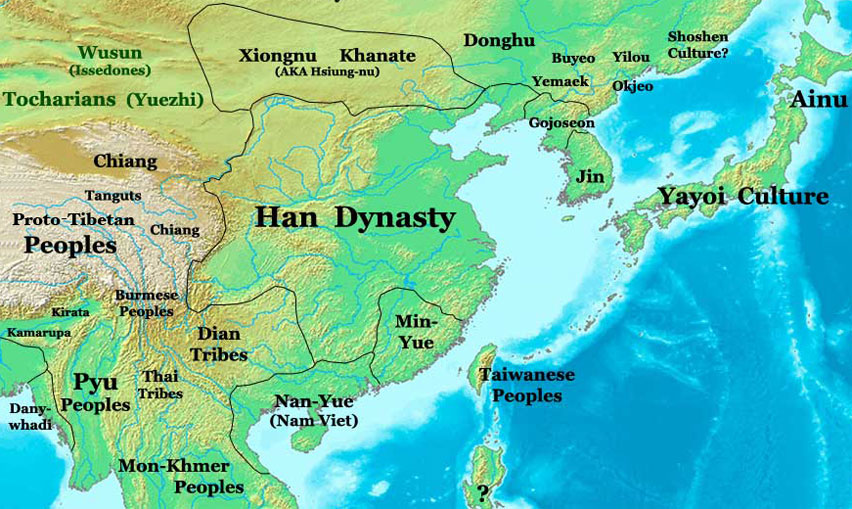
(0:00-0:30): An image of a map of the Han Dynasty is shown.

(0:30-1:00): An image of two statues representing two dancing shamans is shown.

(1:00-1:30): An image of a jade shaman statue, is shown.  

(1:30-2:00): An image of people walking in a forest.

(2:00-2:30): An image of two buddha statues around ornate pillows.

(2:30-3:00): An image of trees in the sunlight.

(3:00-3:30): An image of a yin-yang symbol held in a person’s hands.

(3:30-4:00): An image of a man performing Qigong.

(4:00-4:30): An image of a yin-yang symbol.

(4:30-5:00): An image of a map of the Han Dynasty is shown.

Bibliography

Gengzhe, Yu. 2014. ""Scattered Health" In Chinese Cities Of The Middle Imperial Period". Chinese Studies In History 47 (4): 7-37. doi:10.2753/csh0009-4633470401.

Schiffeler, John Wm. 1976. "The Origin Of Chinese Folk Medicine". Asian Folklore Studies 35 (1): 17. doi:10.2307/1177648.

Schiffeler, John Wm. 1980. "Chinese Folk Medicine A Study Of The Shan-Hai Ching". Asian Folklore Studies 39 (2): 41. doi:10.2307/1178070.


Image Bibliography


2016. Image. http://archive.artsmia.org/art-of-asia/history/images/maps/china-han-large.gif.
2016. Image. https://pixabay.com/static/uploads/photo/2016/02/21/09/33/buddha-1213332_960_720.jpg.
2016. Image. https://pixabay.com/static/uploads/photo/2014/03/20/04/53/martial-arts-291046_960_720.jpg.
2016. Image. https://pixabay.com/static/uploads/photo/2016/04/20/15/36/yin-1341378_960_720.png.
2016. Image. https://pixabay.com/static/uploads/photo/2015/04/12/07/35/hands-718560_960_720.jpg.

Chinese Project Notes: October 20 2016

Cite For My Source


Pg. 3

Disease was attributed to the mystical energy of Qi.

" The ancient Chinese understanding of disease naturally lacked the concept of bacteria and viruses, but qi (气 air or energy) is a factor worth exploring, especially with regards to infectious or epidemic diseases. Qi was regarded as a vehicle for disease: it has passed through many interpretations and can be used to patch the holes in many theories, while its characteristics led people to believe that it could be avoided or resisted but could not be eradicated through public methods."

Pg: 6

Upper-Middle Class Were Served By Physicians

Most people worked with shamans and those who practiced witchcraft.

"many people believed in witches and not in doctors"

" The prevalent practice of moxibustion is one example. The government also encouraged the people to practice self-care: thus, when facing the threat of disease, doctors were never the only force of resistance. Moreover, doctors in ancient China lacked support from religious groups, instead relying completely on the market. As a result, they had only to meet the needs of the “class served by physicians” (primarily the upper-middle class)."

Pg. 7

Doctors didn't actively work to help the populace. Most people didn't trust doctors.

"“Many doctors have adopted this trade in name but not in substance; yet they cultivate an empty reputation in pursuit of material benefit.”9 Arguably, both the elite physicians, who held discursive power, and the lower-class physicians, who constituted the majority in the trade, lacked the motivation to consider the health of the entire populace. According to the doctor–patient relationship of that era, doctors were accustomed to simply wait passively for patients to summon them and lacked the motivation to participate actively in public affairs. For this reason, when facing a large-scale epidemic event, doctors did not necessarily believe that they were the primary line of defense. They had no lack of social responsibility, but they did not elevate this sense of responsibility to the motivation and capacity to take “health measures.”"

General Notes #1

This makes sense because their beliefs were focused around the manipulation of Qi, they believed disease was caused by supernatural entities. Who would you trust to combat negative, supernatural entities? Would you prefer an uneducated doctor attempt to use random medicine to help you, that you don't understand, or would you rather someone who understands the supernatural, help you overcome the supernatural. Even with people trusting shamans more than doctors, the government encouraged self-care, people were motivated to help themselves overcome illness. There are even fatalists who believed that everything is fate, and didn't even fight illness.

General Notes #2

Nicholas Benson: Imagine you are living in Han Dynasty, China. You believe that all disease is caused by a mystical energy, known as Qi. Most doctors are doctor by name alone, and aren't very intelligent. Religious groups don't support the practices of these doctors, and the most elitist doctors are more focused on achieving personal immortality, rather than on public health. Speaking of public health, there is no word for 'health'. The government encourages you take care of yourself, and your friend down the street is a fatalist, so he believes getting sick is simply fate. He's probably going to die soon. Your other neighbor is a shaman, who claims to understand how to manipulate Qi, and help people overcome illness. What is the point of you visiting an uninformed doctor, or a doctor that is more motivated by personal gain, when you can take care of yourself, or visit a shaman down the road who truly understands your troubles?! If you are a member of the lower class, the cheapest option is to take care of yourself, after all, your government thinks its a good idea. If you are middle class, more than likely you don't trust doctors due to their negative reputation. More than likely you'll see a shaman. If you were Upper-Middle Class, more than likely you actually went to see a doctor. Upper-middle class citizens can afford the services of elitist doctors.


Image Citations

2016. Image. http://archive.artsmia.org/art-of-asia/history/images/maps/china-han-large.gif.

2016. Image. https://pixabay.com/static/uploads/photo/2016/02/21/09/33/buddha-1213332_960_720.jpg.

2016. Image. https://pixabay.com/static/uploads/photo/2014/03/20/04/53/martial-arts-291046_960_720.jpg.

2016. Image. https://pixabay.com/static/uploads/photo/2016/04/20/15/36/yin-1341378_960_720.png.

2016. Image. https://pixabay.com/static/uploads/photo/2015/04/12/07/35/hands-718560_960_720.jpg.

Han Dynasty Map. 2016. Image. http://www.nationsonline.org/maps/chinese_dynasty_maps/Han_Dynasty_Map.jpg.

Monday, October 3, 2016

Midterm Review

Mesopotamia

  1. 5000 BCE: Farmers brought crop-raising to Sumer in southern Mesopotamia
  2. 3800 BCE: Uruk expanded into the first city
  3. 2500 BCE: Sumerians established Scribal Schools
  4. 2100 BCE: Mesopotamian temples became ziggurauts 
  5. Cuneiform: Wedge shaped sumerian writing
  6. Polytheism: The worship of many Gods
  7. Hammurabi: Mesopotamia ruler who's greatest accomplishment was the creation of the Hammurabi Code.
  8. Hammurabi Code: Hammurabi's divine authority. A code of law that provides a wealth of information on people's everyday life in Mespopotamia. The code was corrupt, as it allowed for high society to simply pay bribes, but the code called for individuals of lower classes to face an eye for an eye punishment style. Not the first law code in Mesopotamia. 
  9. Epic Poem: Stories of the successes and failures of heroes, that reflect the introspection of the people
  10. 1755 BCE: When Hammurabi's extensive law code was introduced 

Egypt

  1. Pharaoh: Title given to the king of Egypt, derived from a word meaning 'great house'.
  2. 3100-2660 BCE: Unification of Egypt
  3. 2660-2180 BCE: Construction of the pyramids began 
  4. 1570 BCE: Creation of an Egyptian Empire/ The New Kingdom is Formed
  5. 1100-653 BCE: Political fragmentation and conquest caused by outsiders
  6. Gift of the Nile: The Nile's annual and predictable floods, which brought Egypt fertile soil for farming.
  7. Book of the Dead: Collection of funerary manuscripts concerning Egyptian afterlife concepts.
  8. Hieroglyphics: The form of writing used by Egyptians for important religious and political texts.
  9. Hieratic: A simpler form of writing that allowed for scribes to write more quickly, and was used for documents of daily life.
  10. Hatshepsut: One of the few female pharaohs, who existed during the New Kingdom, and promoted building and trade.

Harrappa India 

  1. 2500-2000 BCE: Harrapan Civilization Thrived
  2. 2500 BCE: Sophisticated Bronze Age Urban Culture Is Established in India
  3. Harrapan Script: The Harrapan language that was incised on clay tablets and seals.
  4. Mohenjo-Daro: Was a planned Harrappan City that had drainage pipes, and straight streets.
  5. Great Bath: Is believed to have been a ritual pool for purification.
  6. Lothal: Major port for exit and entry in Harrapan India
  7. Cotton cloth: Cloth made of cotton, Harrapa was one of the earliest manufacturers of this.
  8. Harrapan Cities: Weren't formed by villages that grew out of control, but rather were built ahead of time to be settled into.
  9. Sanitation System: An advanced system for waste removal. Harrapan is the only ancient civilization to have a sanitation system.
  10. Indus River: Provided rich, fertile soil for the Harrapan Civilization. 

Ancient China

  1. Book of Documents: Describes the Zhou conquest of the Shang, as just noble warriors defeating a sadistic king and his irresponsible followers.
  2. Mandate of Heaven: The theory that heaven gives the king a mandate to rule only as long as he rules in the interests of the people.
  3. Shi: The lower ranks of Chinese aristocracy, these men could serve in either military or civil capacities.
  4. Book of Songs: The earliest collection of Chinese poetry, it provides glimpses of what life was like in the early Zhou Dynasty.
  5. 1050 BCE: The Zhou rose against and defeated the Shang
  6. 900 BCE: When the Book of Documents were organized
  7. 800 BCE: There were two hundred lords with their own domains
  8. 771 BCE: Zhou King was killed by an alliance of non-Chinese tribesmen and Zhou vassals
  9. 500 BCE: Citie began appearing all across northern China, as social and economic change quickened
  10. 403-221 BCE: The Warring States Period

Indian Religions: Jainism and Buddhism

  1. 520 BCE: When Mahavira founded Jainism
  2. 500 BCE: Founding of Buddhism
  3. Mahavira: The founder of Jainism
  4. Jainism: Indian religion, in which everything has a soul, and everything has karma
  5. Ahimsa: Non-violence
  6. Kharma: One's bad deeds that weigh them down, and prevent them from escaping Samsara
  7. Samsara: The Illusory Universe, Cycle of Reincarnation
  8. Buddhism: Religion with the goal of achieving Nirvana, releasing one's detachments, to remove all suffering 
  9. Four Noble Truths: The Buddha's message that pain and suffering are inescapable parts of life, that suffering is caused by human desires and attachments, people can triumph over their weaknesses, and that triumphing over weaknesses is possible by following a simple code of conduct.
  10. Eightfold Path: The code of conduct set forth by the Buddha in his first sermon, beginning with "right conduct" and ending with "right contemplation".

Indian Religions: Hinduism

  1. 400 BCE: When Hinduism Started
  2. Hinduism: Religion with the goal of escaping Samsara
  3. Upanishads: Taught/Introduced the Way of Wisdom
  4. Moksha: Escaping Samsara
  5. Samsara: The cycle of reincarnation, the illusory universe.
  6. Dharma: One's place in the universe, one's true destiny. The moral law, and Hindu teachings. 
  7. Way of Withdrawl: Asceticism and meditation on the Vedas, with no accumulated bad karma
  8. Way of Wisdom: Realizing that you are a part of the universe, by reading the Upanishads, which allows you to be released from Samsara, and become one with the universe
  9. Way of Works: You work your way through the caste system, until you are re-incarnated as a male Brahman, and are released from Samsara
  10. Atman: Divine that is within you

Chinese Religions: Confucianism, Taoism, Legalism

  1. Analects: Collection of Confucian sayings put together by his followers after his death
  2. 551-479 BCE: Time of Confucius
  3. Confucianism: Practice of the five relationships and filial piety
  4. Taoism: Going with the flow, to become one with the Dao
  5. Ren: The ultimate Confucian virtue, it is translated as perfect human-heartedness and nobility.
  6. Five Relationships of Confucianism: Ruler and subject, father and son, husband and wife, elder brother and younger brother, friend and friend
  7. Junzi: Gentleman, man of moral cultivation, rather than of noble birth
  8. 369-286 BCE: When Laozy founded Taoism 
  9. The Dao: The way, a term used by Daoists to refer to the natural order and by Confucians to refer to the moral order.
  10. Legalism: Belief that laws should be heavily enforced, because without strong laws, people won't do the right thing. The belief that humans are naturally evil, and have to have strict laws and punishments to prevent them from being evil.

Zoroastrianism

  1. Zoroastrianism
  2. Dualism
  3. Zoroaster
  4. Ahura Mazda
  5. Three Layers of Ahura Mazda’s Feathers: good relections, good deeds, good words
  6. Ahriman / Angra Mainyu
  7. 6th Century BCE: When Zoroastrianism was founded
  8. 7th Century CE: When Islam became more popular than Zoroastrianism
  9. Prophet
  10. Freewill: In zoroastrianism, the people had the power to choose between working alongside with Ahura Mazda and the light, or fall with Ahriman into the darkness.

Achaemenid Persians

  1. Satraps: The governors of the individual provinces, that divided Persia, known as Satraps.
  2. Satrapies: The provinces that divided Persia, and were ruled over by Satraps
  3. 550 BCE: Cyrus the Great (King of Persians) conquered the Medes
  4. 559-530 BCE: The Time of Cyrus the Great
  5. 521-486 BCE: The Time of Darius
  6. Darius: Calling himself the King of Kings, who divided the empire into Satraps, lead by Satrapies.
  7. 1000-500 BCE: The Time of the Assyrian and Persian Empires
  8. 1000 BCE: Indo-Europeans migrated to Iran
  9. Realistic Monumental Sculpture: Persians used them to show persians as being dignified
  10. 600 BCE: Zoroastrianism takes root in Persia

Mauryan

  1. 326 BCE: The Persian Empire Succumbed to Greece
  2. 322 BCE: Greeks supplanted the Persians in Northwest India, Giving Chandragupta 
  3. 322 BCE to 185 BCE: The Mauryan Empire 
  4. Megasthenes: Greek ambassador sent by Seleucus who spent fourteen years in Chandragupta's court. His writings detail many elements of everyday life in the Mauryan Empire.
  5. Chandragupta: Personally presided over court sessions, claimed all mines and forests for the state, controlled prostitution, and had kings in outlying areas of the empire pledge loyalty to Chandragupta.
  6. Beaurecratic Departments: Utilized many departments that regulated many of the elements of Mauryan government.
  7. Janapadas: Families in rural areas that acted as local rulers who: brokered trade, worked on public works, and enforced justice.
  8. Panchagats: Five men who had the most power and influence in a specific city or town.
  9. Pulisani: Public relations officers, who traveled around the empire, and reported public opinion back to the emperor.
  10. Dharma Officials: Travel the empire, tell people to follow the dharma, and go to every house in the empire.

Axum

  1. Aksum: A kingdom in northwestern Ethiopia that was a sizable trading state and the center of Christian Culture.
  2. 200 BCE to 650 BCE: Time of the Aksum Empire
  3. Tef, Millet, and Coffee: The three major foods of the Aksum Empire
  4. King of Kings System: Kings paid taxes to the main king
  5. Monophysites: Individuals who believe Jesus is God
  6. Mahrem: The main god of their culture, who was believed to have had a convenant with Yahweh.
  7. Gospels: The oldest gospels in the world are from Ethiopia
  8. Sheba and Solomon: Were believed to have had sex with one another, and then stole the Ark of the Covenant
  9. Coins: Aksum printed the first coins with Christrian crosses on them, in the world.
  10. Betse: Fatal African sleeping sickness

Qin-Han

  1. Three Ministries: The government during the Qin-Han Dynasty made up of these three departments: Civil, Military, and Censorate departments.
  2. Civil Department: Performed public works
  3. Military Department: Enforced laws
  4. Censorate Department: Removed bureaucrats from office, who weren't enforcing legalism.
  5. Civil Service Exams: Tests that allowed people the opportunity to become a member of one of the three departments of the three ministries.
  6. 3rd Century BCE: They commissioned for the creation of a dictionary. Dictionaries standardize language and word meaning.
  7. 105 CE: Paper is invented
  8. Sericulture: Silk making. China was the only area in the world at the time that knew how to make silk.
  9. Silk Roads: The many paths used by China to travel and trade silk.
  10. Census: They took a census of their population, and utilized that information for military service and taxation regulation.
  11. Mandate of Heaven: Was claimed by Qin-Han. Zhaou was the original writer of the mandate of heaven.

Wednesday, August 31, 2016

Lab Questions: Lab 1 and Lab 1.5

Lab One: Questions Two and Three

Question 2

PV = 60000 #You Borrow $60,000
r = 0.05 # Yearly Interest = 5%
n = 8 # 8 years
r = r/12 #Monthly Payment
n = n*12 #96 months
top = r* PV
bottom = 1-(1+r)**-n
fraction = top / bottom
P=fraction
print ("P = "+str(P))
print ("PV = "+str(PV))
print ("Monthly Interest = "+str(r))
print ("Number of Periods in Months = "+str(n))


Question 3

PV = 60000 #You Borrow $60,000
r = 0.05 # Yearly Interest = 5%
n = 48 
r = r/12 #Monthly Payment 
#96 months
P=759.59520072743
part1=PV*(1+r)**n
part2=P*((((1+r)**n)-1)/r)
FV=part1-part2
print(FV)

Lab 1.5 Questions 1-3

Question 1

import math
from builtins import printfrom builtins import strr = 0.06 #Annual Interest RateP = 1000 #Beginning Balance of a Savings Accountt = 2 #Number of Yearsn = 1v = (P)*((1)+(r/n))**(n*t)
va = (P)*((1)+(r/12))**(12*t)
vb = (P)*((1)+(r/365))**(365*t)
vc = (P)*((1)+(r/8760))**(8760*t)
print ("Compounded Yearly: Balance After Two Year(s)= " +str(v))
print ("Compounded Monthly: Balance After Two Year(s)= " +str(va))
print ("Compounded Daily: Balance After Two Year(s)= " +str(vb))
print ("Compounded Hourly: Balance After Two Year(s)= " +str(vc))
print ("Limit = $" +str(P*math.e**(r*t)))

Question 2

import math
from builtins import print

P = 100r = (0.06/12)
n = 2 * 12FV = (P)*((((1+r)**n)-1)/r)
print("FV = $"+str(FV))

Question 3

import math
from builtins import print
P = 100r = 0.06/12FV = 4000


a = (1 + ((FV * r)/P))
b = math.log(a)
c = 1+r
d = math.log(c)
print ("Number of Periods = "+ str(b/d))

History Reading Notes: August 31 2016


  • Pg.102-106 Under Confucius and His Followers
    • Pg.102
      • During the same period in which Indian sages and mystics were developing religious speculation about karma, souls, and ultimate reality... 
        • Chinese thinkers were arguing about the ideal forms of social and political organization and man's connection to nature.
    • Pg.103
      • In the Confucian tradition, studying texts came to be valued over speculation, meditation, and mystical identification with deities
      • Confucius encouraged men who came to study with him to master rituals, that we know today as Confucian classics
      • Mencius's philosophy for leadership and politics appears to be strongly connected with the concepts laid out in the mandate of heaven
      • Xunzi believed that ritual, was key to teaching people how to place moral principles, above one's own interests
    • Pg.104-105
      • Confucius had declined to discuss gods, portents, and anomalies and had spoken of sacrificing as if the spirits were present
      • Xunzi argued explicitly that heaven does not intervene in human affairs
      • Xunzi did not propose abandoning traditional rituals
        • Xunzi believed rituals.... 
          • Had positive effects on those who practiced and observed them
          • Allowed people to express feelings and satisfy desires in an orderly manner 
          • Specified ways to perform rites based on social rank and religious conditions
          • Help to sustain the social hierarchy
    • Pg.106
      • Xunzi believed rituals...
        • Shaped people's sense of duty, while creating social differentiation 
      • Repaying ancestors was seen as a sacred duty, as one could never have existed without the existence of those before them
  • Pg.96-97
    • The King of Zhou was known as The Son of Heaven
    • The Mandate of Heaven States..
      • Heaven chooses the worthiest man to be king
      • A king can loose their worth
      • Heaven can replace an unworthy king, with the worthiest man
    • Zhou Kings sacrificed not only to their ancestors, but to heaven
      • Sacrifices to ancestors were key rituals that were used to forge social ties
  • Pg.93-94
    • The Shang King was also a high priest
      • The Shang King was most qualified to offer sacrifices to royal ancestors and the high god Di
        • The Shang King divined his ancestor's wishes by interpreting the cracks made in heated cattle bones or tortoise shells prepared for him by professional diviners
        • Royal ancestors are believed to be able to intervene with Di, allowing them to..
          • Send Curses
          • Produce Dreams
          • Assist The King In Battle
    • During the Shang Dynasty, tombs would contain...
      • Weapons
      • Treasures
      • Living Servants
    • Cicadas symbolize..
      • Rebirth in the realm of ancestral spirits
    • Birds were considered to be able to...
      • Send messages to other realms
        • Especially sky realms
    • The Taotie
      • An image of a monster used to scare away evil forces
      • Stylized animal face
  • Pg. 108 Zhuangzi's Story About Death
    • Zhuangzi Outlines Creation to Death As The Following Process...
      • In the amorphous realm, something changes and life energy appears...
      • Life energy then takes form, changes form, and life begins....
      • Another change occurs..and then death
  • Pg. 110-111 Xunzi's View of Rituals / Divine Animals/ Astrology/ Divination/ Astral Gods/ Exorcism
    • Animals that were considered divine include...
      • Dragons
      • Phoneixes 
    • The popular religion of the time was..
      • Astrology
    • The View of Illness Presented By Divination Was....
      • Illness is due to the presence of unsatisfied spirits or malevolent demons, best dealt with through performing exorcisms or offering sacrifices to the astral god Taiyi
  • Chapter Summary
    • Pg. 111
      • Slaves + Gods = Revenue?
        • Slaves captured during the war, were sacrificed to the Gods, in order to supply the Shang king with revenue.
      • The Book of Documents 
        • Mandate of Heaven
          • Justified Zhou rule and the overthrow of the Shang Dynasty by stating that...
            • A king must rule in the interests of the people
            • A kind who does not rule in the interests of the people is not worthy to be king
            • Heaven can remove the power of an unworthy king and transfer it to a new and worthier king
      • The Warring States Period
        • Xunzi stressed that ritual is important to society because...
          • It provided order to the people
            • How?
              • Rituals were conducted differently depending on class
              • Rituals allowed for an orderly way for people to deal with emotions
              • Practicing rituals promotes traditional ideas, and keeps traditions thriving
        • Natural Philosophers
          • Explained the world through the feminine and masculine forces of yin and yang

History Reading Notes: August 31 2016


  • Pg.102-106 Under Confucius and His Followers
    • Pg.102
      • During the same period in which Indian sages and mystics were developing religious speculation about karma, souls, and ultimate reality... 
        • Chinese thinkers were arguing about the ideal forms of social and political organization and man's connection to nature.
    • Pg.103
      • In the Confucian tradition, studying texts came to be valued over speculation, meditation, and mystical identification with deities
      • Confucius encouraged men who came to study with him to master rituals, that we know today as Confucian classics
      • Mencius's philosophy for leadership and politics appears to be strongly connected with the concepts laid out in the mandate of heaven
      • Xunzi believed that ritual, was key to teaching people how to place moral principles, above one's own interests
    • Pg.104-105
      • Confucius had declined to discuss gods, portents, and anomalies and had spoken of sacrificing as if the spirits were present
      • Xunzi argued explicitly that heaven does not intervene in human affairs
      • Xunzi did not propose abandoning traditional rituals
        • Xunzi believed rituals.... 
          • Had positive effects on those who practiced and observed them
          • Allowed people to express feelings and satisfy desires in an orderly manner 
          • Specified ways to perform rites based on social rank and religious conditions
          • Help to sustain the social hierarchy
    • Pg.106
      • Xunzi believed rituals...
        • Shaped people's sense of duty, while creating social differentiation 
      • Repaying ancestors was seen as a sacred duty, as one could never have existed without the existence of those before them
  • Pg.96-97
    • The King of Zhou was known as The Son of Heaven
    • The Mandate of Heaven States..
      • Heaven chooses the worthiest man to be king
      • A king can loose their worth
      • Heaven can replace an unworthy king, with the worthiest man
    • Zhou Kings sacrificed not only to their ancestors, but to heaven
      • Sacrifices to ancestors were key rituals that were used to forge social ties
  • Pg.93-94
    • The Shang King was also a high priest
      • The Shang King was most qualified to offer sacrifices to royal ancestors and the high god Di
        • The Shang King divined his ancestor's wishes by interpreting the cracks made in heated cattle bones or tortoise shells prepared for him by professional diviners
        • Royal ancestors are believed to be able to intervene with Di, allowing them to..
          • Send Curses
          • Produce Dreams
          • Assist The King In Battle
    • During the Shang Dynasty, tombs would contain...
      • Weapons
      • Treasures
      • Living Servants
    • Cicadas symbolize..
      • Rebirth in the realm of ancestral spirits
    • Birds were considered to be able to...
      • Send messages to other realms
        • Especially sky realms
    • The Taotie
      • An image of a monster used to scare away evil forces
      • Stylized animal face
  • Pg. 108 Zhuangzi's Story About Death
    • Zhuangzi Outlines Creation to Death As The Following Process...
      • In the amorphous realm, something changes and life energy appears...
      • Life energy then takes form, changes form, and life begins....
      • Another change occurs..and then death
  • Pg. 110-111 Xunzi's View of Rituals / Divine Animals/ Astrology/ Divination/ Astral Gods/ Exorcism
    • Animals that were considered divine include...
      • Dragons
      • Phoneixes 
    • The popular religion of the time was..
      • Astrology
    • The View of Illness Presented By Divination Was....
      • Illness is due to the presence of unsatisfied spirits or malevolent demons, best dealt with through performing exorcisms or offering sacrifices to the astral god Taiyi
  • Chapter Summary
    • Pg. 111
      • Slaves + Gods = Revenue?
        • Slaves captured during the war, were sacrificed to the Gods, in order to supply the Shang king with revenue.
      • The Book of Documents 
        • Mandate of Heaven
          • Justified Zhou rule and the overthrow of the Shang Dynasty by stating that...
            • A king must rule in the interests of the people
            • A kind who does not rule in the interests of the people is not worthy to be king
            • Heaven can remove the power of an unworthy king and transfer it to a new and worthier king
      • The Warring States Period
        • Xunzi stressed that ritual is important to society because...
          • It provided order to the people
            • How?
              • Rituals were conducted differently depending on class
              • Rituals allowed for an orderly way for people to deal with emotions
              • Practicing rituals promotes traditional ideas, and keeps traditions thriving
        • Natural Philosophers
          • Explained the world through the feminine and masculine forces of yin and yang

Tuesday, August 30, 2016

History Notes


Health and Medicine in Chinese History.
Authors:
Wang, Q. Edward1
Xinzhong, Yu2
Source:
Chinese Studies in History. Summer2014, Vol. 47 Issue 4, p3-6. 4p.
Document Type:
Article
Subject Terms:
*MEDICAL care
*HISTORY
CHINA
Abstract:
An introduction is presented to the issue of the journal that discusses topics such as the history of medical practice in China, protection against disease in urban environments, and commercial advertisements for drugs.
Author Affiliations:
1Chinese Studies in History
2Nankai University, Tianjin, China
ISSN:
0009-4633
DOI:
10.2753/CSH0009-4633470400
Accession Number:
98560630
http://eds.b.ebscohost.com.elib.uah.edu/ehost/pdfviewer/pdfviewer?sid=2f92e016-1461-4388-abf0-25b715fa6c79%40sessionmgr120&vid=4&hid=117